
Hand Tools
Let me say this straight away: there is no such thing as too many tools. Fortunately, the market offers just about everything one could want, for every taste and budget. Here, however, I will divide them into three groups:
- tools needed for any model and making the building process much easier
- tools that are useful and often make the work faster or more comfortable, but whose absence will not stop the build
- tools needed for specific operations or certain types of models, but not, in my view, essential for building a model strictly by the kit instructions
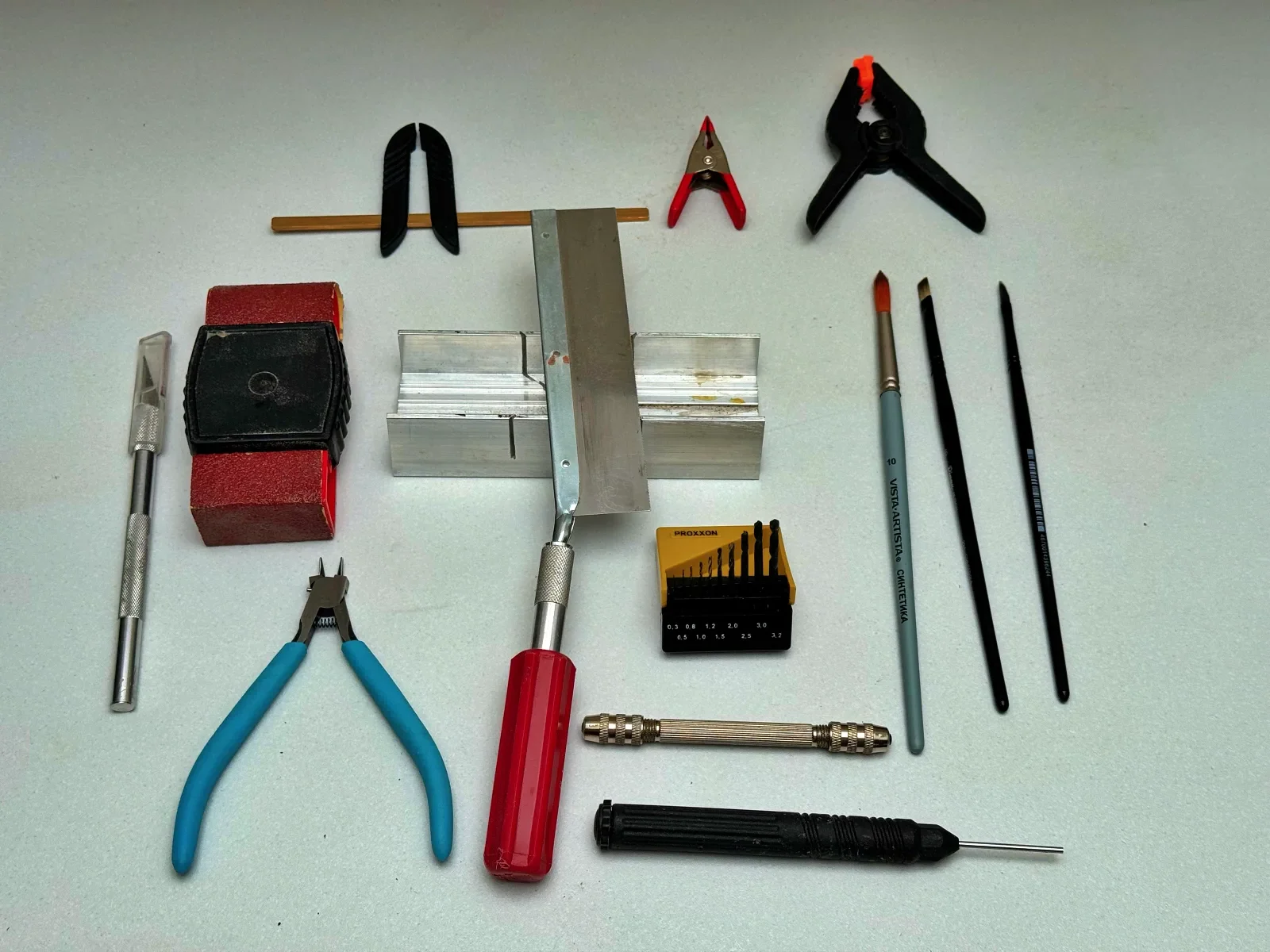
The absolutely essential tools are:
- Model knife. Indispensable for removing parts from the sheet or sprue and for fitting parts, especially thin strips. If you have nothing else, a model knife can perform almost any operation, although some of them will be slow and inconvenient. Cutting thread, trimming parts, even removing excess glue — all of that can be done with it.
- Sanding block. Yes, you can hold sandpaper directly in your hand or lay it on the table for small parts. But the effort involved will be completely out of proportion to the quality of the result. Put simply: you will get tired and disappointed. Definitely worth having.
- Small saw and miter box. Very useful when the strip is more than 1 mm thick and the knife simply will not cut it. At that point, a fine-toothed saw becomes essential.
- Hand drill and drill set from 0.3 mm to 1.5 mm. You will do a lot of drilling, so a micro-drill would be better right away, but we agreed to talk about power tools separately. Still, without a drill you can neither install a treenail nor attach an eyebolt.
- Nail inserter. It may seem like an exotic tool — why not just use a hammer? Try pulling a strip tight against a bulkhead in a hard-to-reach area when you have only two hands and one of them is holding a hammer ☺ With this tool, you load the tiny nail, place it against the spot, press a few times, and the job is done. That is why the hammer will go into the next section, while the nail inserter stays here.
- Needle-nose pliers. Useful whenever something needs to be held but your fingers are too clumsy and tweezers are too weak — or simply not at hand.
- Clamps — clothespins and mini clamps. We glue a lot, and parts need to be held in place somehow, so these are essential.
- 80 and 220 grit sandpaper.
- Brushes in two or three sizes. Usually flat brushes, except perhaps for the very smallest one.
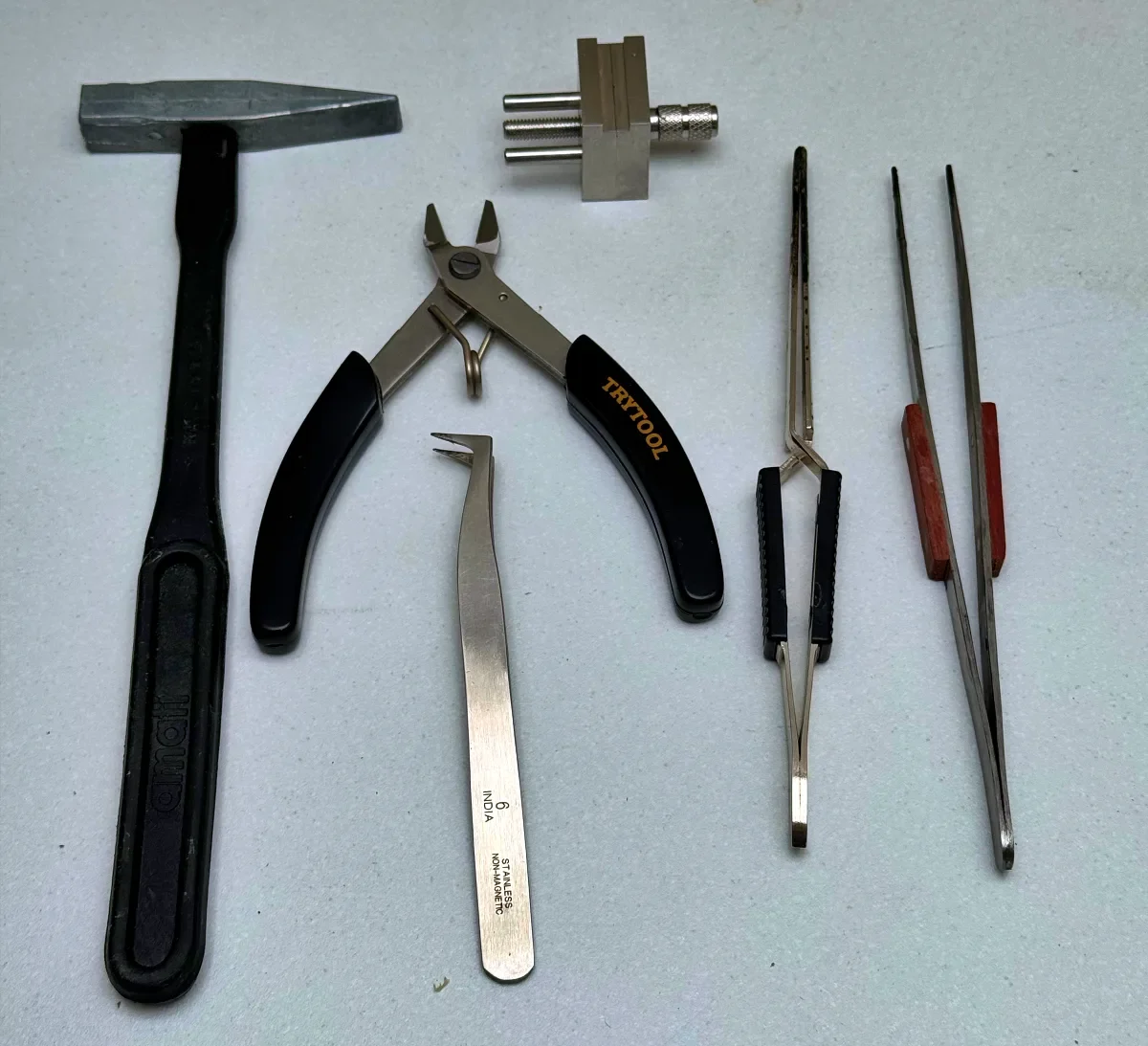
The second group: needed, helpful, but not essential enough to stop the work if you do not have them.
- Model hammer. A small one, 80–150 grams. Useful, for example, when installing rough planking. Some have interchangeable faces.
- Photo-etch side cutters with very fine jaws. They are simply more convenient than a knife for removing metal photo-etched parts from the fret.
- Tweezers. Better to have several. Needed for handling small parts and rigging.
- Small vise.
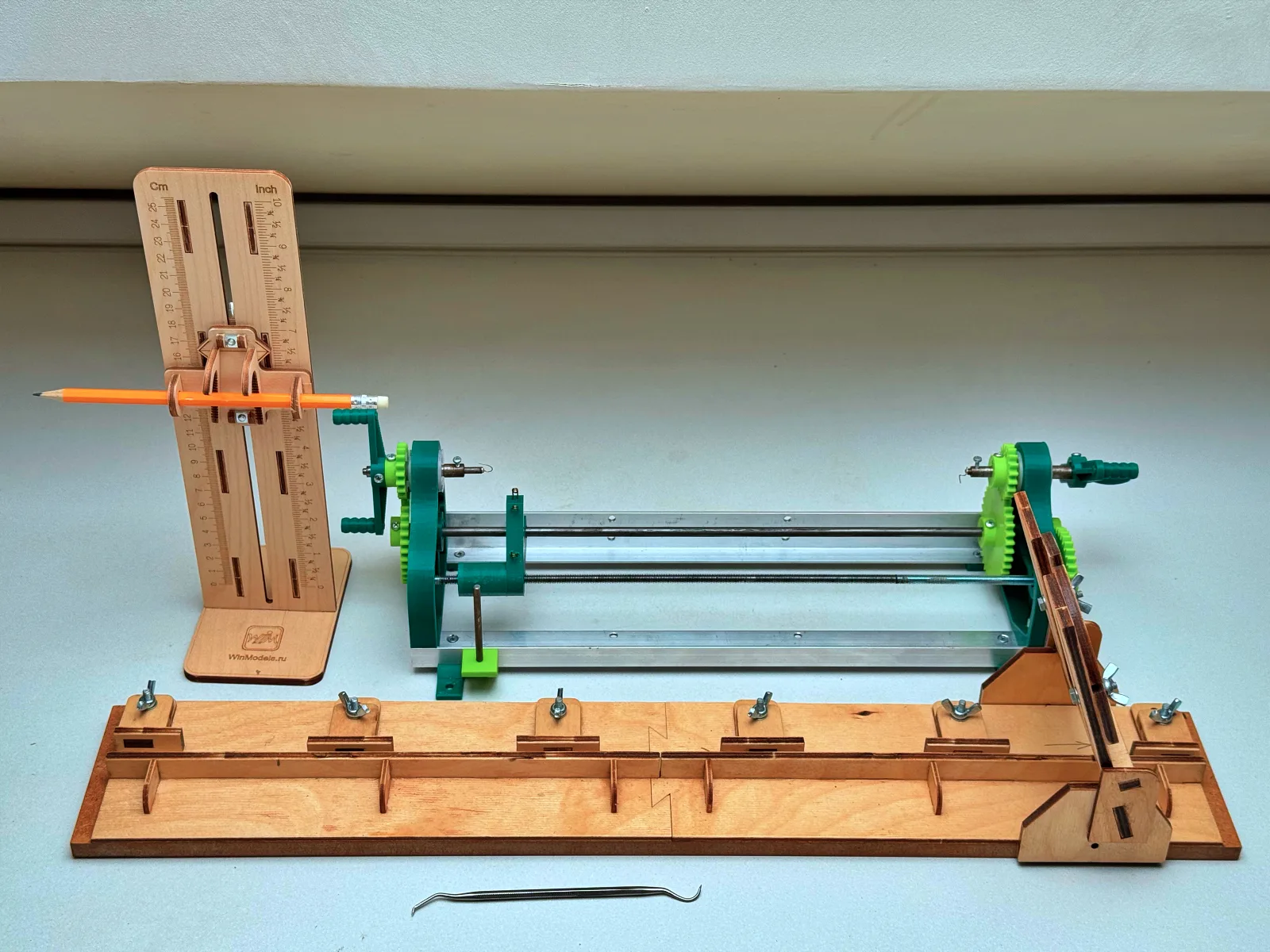
These are tools you can certainly live without, but they make life easier and the models better.
- Building slip. Extremely helpful whenever you need both hands free — deck work, spars, rigging, and so on.
- Rope serving tool. If you are not yet building large-scale models, not aiming at a high level of detail, or simply did not understand the name of this tool, then you probably do not need it yet. But beauty in a model often lives in the details, and served rigging is one of those details.
- Rigging hooks. These often let you lead a line through a tight area in seconds where you might otherwise spend 20 minutes doing it by hand.
- Waterline marking tool.