
Power Tools and Machines
No power tool is strictly a first necessity. So I will divide them into two groups: handheld power tools and machines. The order within each group simply reflects my own subjective sense of priority.
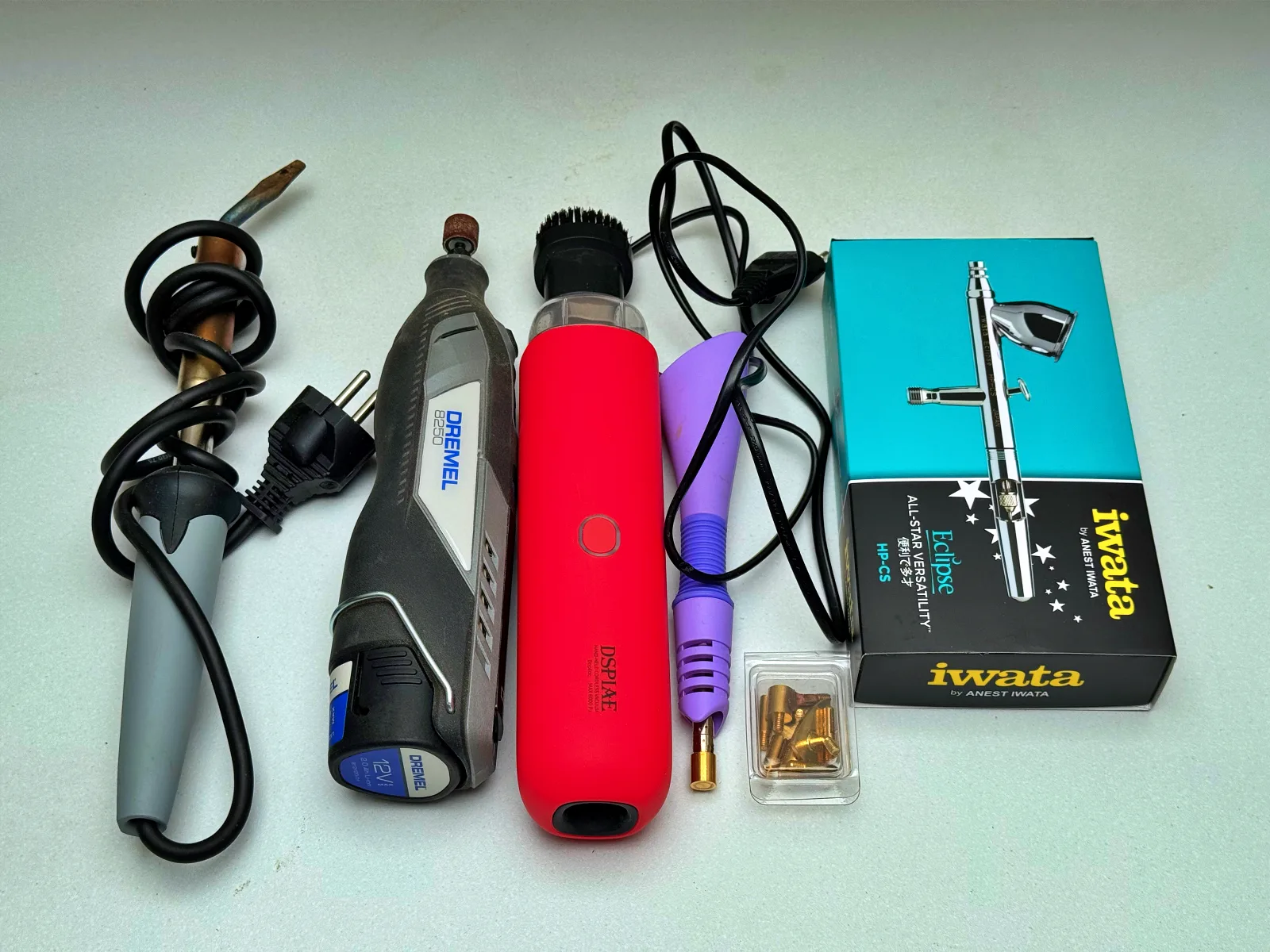
- Rotary tool. For me, this is one of the most frequently used tools. Everything depends on the attachments, of course, but it makes almost every kind of work easier: drilling, fitting parts, milling, sanding, metal work, and much more. There is a huge range available — corded or cordless, collet or chuck, famous brand or no-name. I will not get into that discussion here, except to say that I use a cordless Dremel simply because that is how things worked out historically. As for attachments, drill bits and sanding drums are the first essentials; the rest can be bought as needed.
- Heat applicator. Usually this tool is sold for attaching rhinestones to fabric. I use it for fixing thin strips with glue, almost like a hot press, and sometimes for bending wood.
- Soldering iron. For working with metal and sometimes with plastic. I prefer a gas soldering iron because it seems more versatile to me.
- Vacuum cleaner. Dust and sawdust are constant companions of the modeler. Without a vacuum cleaner, the time spent cleaning the workspace after each session increases dramatically.
- Airbrush. This already belongs to the subject of painting. There are countless materials about choosing an airbrush, so there is no need to add one more. It is a good tool, but not an essential one.
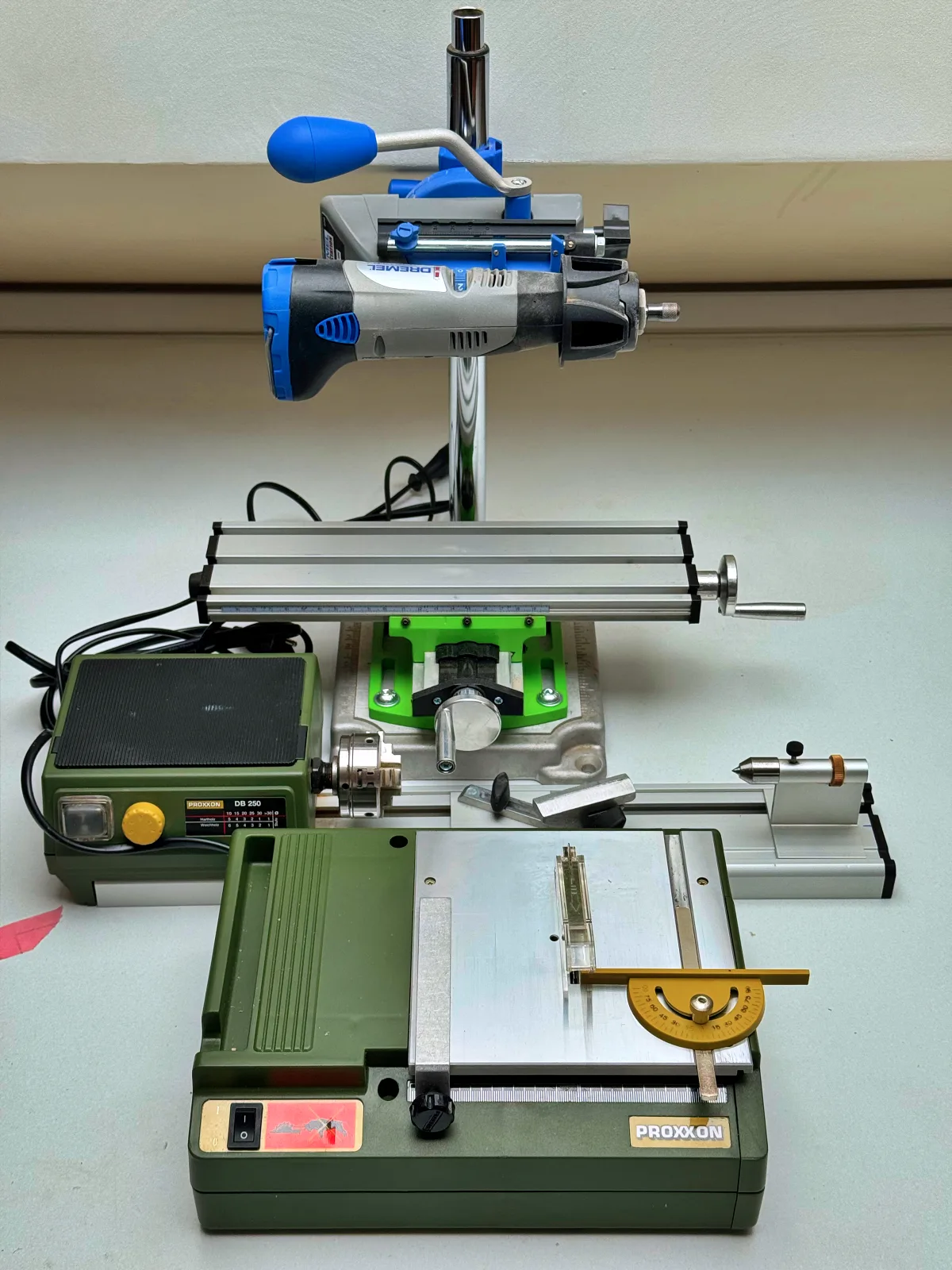
By “machine,” I mean a power tool in which the working element is fixed and moved by a mechanism rather than by hand.
- Drill press. Or a stand for the rotary tool from the first group. It is indispensable for accurate drilling with very fine drill bits, because a thin bit is very easy to break when drilling freehand. Combined with a cross-slide table, it can also be used for simple milling.
- Lathe. It makes life much easier when working with spars, especially if you plan to make them yourself, for example from hexagonal stock. Do not forget to buy a good set of turning tools right away — they determine the result.
- Circular saw. If you need to cut several dozen deck planks to exactly the same length or to the same angle, this is the tool for the job. But do not expect miracles from a hobby-grade machine tool: the maximum cutting depth is only about 8–12 mm, and it is not meant for hours of continuous work. Still, the cut is clean and it saves a great deal of time. One important note: do not let sawdust build up, and if you can connect a vacuum cleaner, definitely do so.
- Band saw. This is very much a nice-to-have item. For example, if you have access to larger wood blanks and want to rip them down to a size suitable for the circular saw, or prepare stock for later turning on the lathe.